
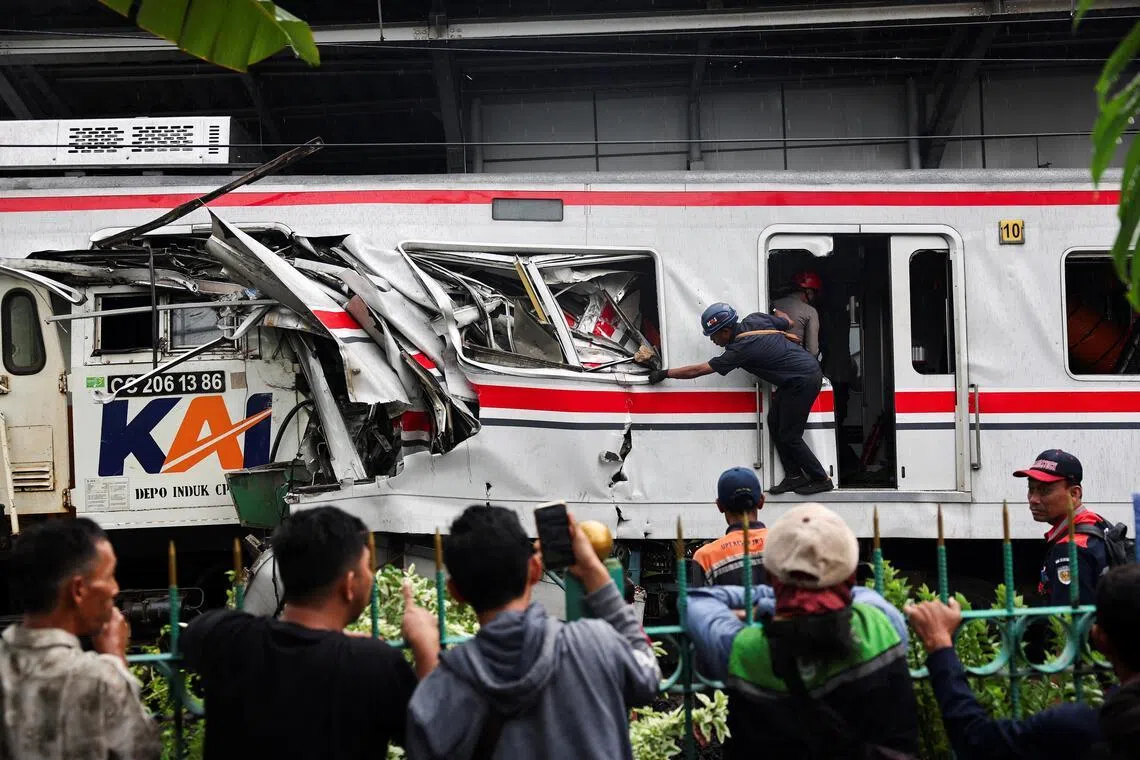
Instran.id – Months before a commuter train carriage was crushed in Bekasi, outside Jakarta, Indonesian ministers were speaking of the next leap forward: extending the China-backed high-speed rail line, Whoosh, which now runs from Jakarta to Bandung, further to Surabaya.
The proposed route would slice across Java, cutting one of Indonesia’s longest overland journeys from up to 10 hours to around three hours. Then came one of the country’s deadliest rail disasters on April 27, which killed 15 people and injured dozens.
On the night of April 27, a commuter line train stopping at East Bekasi station in West Java was struck from behind by a long-distance Argo Bromo passenger train, a conventional express service headed towards Surabaya, East Java.
The collision did not happen on Whoosh, but on the conventional rail network that still carries millions of commuters and long-distance passengers each day across Jakarta and its surrounding satellite cities, known by the acronym Jabodetabek, as well as the island of Java.
The incident has reignited debate over whether Indonesia should prioritise ambitious high-speed rail projects, improve the network most people use, or spend more on transport beyond Java.
The railway most Indonesians use
Whoosh, launched in late 2023, is Indonesia’s flagship rail project under former president Joko Widodo and part of China’s signature Belt and Road Initiative.
But for most Indonesians, daily travel still depends on the conventional commuter and inter-city rail network. Before sunrise, millions of workers and students crowd platforms bound for Jakarta. By evening, the same stations fill again with homebound passengers.
Top stories
Explore top stories from all sections in one place
Under UNCLOS, coastal states bordering international straits are barred from hampering transit passage or discriminating “in form or fact” against vessels of different states, says the writer.
Opinion
Obsessed? A joint fixation on maritime rules is in Asean’s shared interest
Iran’s blockade of the Strait of Hormuz has cut off flows of oil, gas and fertiliser and sent prices soaring.
World
Peace efforts stall as US examines latest Iran proposal
jlcarpark – Under an arrangement that dated back to at least 2017, the management corporation (MCST) of WCEGA Plaza and Tower allowed the WCEGA Used Car Association (WUCA) to operate 58 basement parking spaces. Photo taken on 28 April, 2026.
Singapore
Parking dispute ends with High Court ruling on proxy cap in strata developments
MiroMind – founded by Chen Tianqiao, a pioneer of China’s online gaming industry – employs more than 60 scientists across locations including Singapore, Tokyo, and Seattle.
Business
Chinese billionaire overhauls AI start-up, which has scientists in Singapore, after Manus warning
Billionaire Elon Musk being questioned by his attorney Steven Molo during his lawsuit over OpenAI for-profit conversion at a federal courthouse in Oakland, California.
World
It’s not OK to ‘loot a charity’: Elon Musk testifies at OpenAI trial
The Lightweight BVLOS Drone Box System (centre) on display at the Milipol TechX Summit 2026 held at the Sands Expo and Convention Centre on April 28.
Singapore
Singapore developing drones to be deployed across island for public safety
In the minute-long Instagram reel, a service crew member wearing a blue polo shirt is seen throwing bags onto the belt.
Singapore
SATS apologises for service crew seen tossing bags onto Changi Airport belt
A Chinese passenger created a ruckus on an AirAsia flight after cabin crew members spoke to her in English, not Mandarin.
Asia
Entitled or self-centred? Unpacking the AirAsia passenger outburst
The Bekasi collision has renewed scrutiny of that system’s weak points, including signalling discipline, incomplete automatic train protection systems, driver fatigue management and safeguards for critical signals.
Even so, analysts said conventional rail operations have improved markedly over the past decade following reforms at state operator PT Kereta Api Indonesia.
“If we look back, railway operations over the past 15 years have been quite good, with no major accidents,” Mr Ki Darmaningtyas, a transport analyst from the Strategic Transportation Initiative, a Jakarta-based advocacy group, told The Straits Times. “So if you ask what the problem is with conventional railways, there is relatively little problem.”
One of the network’s most persistent hazards, however, remains level crossings. Across Java, roads still intersect railway lines in many places. Motorcycles edge around barriers, cars try to beat warning bells, and traffic jams can leave vehicles stranded on the tracks.
The latest crash is still under investigation, but early indications point to such a violation. The police said on April 28 that they were questioning a taxi driver after his electric car allegedly crossed recklessly, suffered a short circuit on the tracks, and was struck by a commuter train, disrupting subsequent rail services.
“First, illegal and unsafe level crossings must be brought under control,” Mr Djoko Setijowarno, a civil engineering lecturer at Soegijapranata Catholic University, told ST. Despite warning systems and regulations, too many people still ignore them.
“Even when crossings are closed, people still force their way through, especially at unguarded crossings. That is the real issue,” he said, adding that flyovers and underpasses would be effective solutions.
He also called for firmer law enforcement and transport safety education “so children learn from an early age how to travel safely and obey traffic rules”.
The incident has reignited debate over whether Indonesia should prioritise ambitious high-speed rail projects or improve the network most people use.
Mr Deddy Herlambang, chairman of the Indonesian Transportation Society Railway Forum, said similarities with Indonesia’s last major train-on-train crash in 2010 in Pemalang, Central Java, raise questions over signalling discipline and why automatic train protection systems remain incomplete more than a decade after regulations called for them.
The 2010 crash killed 35 people and injured 34 others.
“There must be a culture of safety over punctuality,” he told ST.
For hours, her family didn’t know if she was alive: Women-only coach bore brunt of Jakarta train crash
Indonesia train crash toll rises to 15 as rescuers complete evacuation
On April 28, President Prabowo Subianto said the government would “tidy up” 1,800 railway crossings on Java, many dating to the Dutch colonial era. He estimated the programme would cost nearly 4 trillion rupiah (S$296 million).
Mr Deddy said “4 trillion rupiah for transport safety is very small” compared with the 335 trillion rupiah earmarked in 2026 for Mr Prabowo’s flagship Nutritious Meals Programme.
Mr Darmaningtyas said such crossings are not under the railway operator’s authority, but fall to the central government for national roads, provincial administrations for provincial roads, and regency or city governments for local roads.
With responsibility split among multiple authorities, fixing the problem will require not only law enforcement and coordination, but also money.
Should Whoosh go to Surabaya?
Mr Agus Harimurti Yudhoyono, Coordinating Minister for Infrastructure and Regional Development, said in March 2026 that extending the line from Bandung to Surabaya could be a “game changer” for national development by creating new economic growth along the route.
Officials have also said the line could eventually be extended further east to Banyuwangi, in East Java, in line with Mr Prabowo’s guidance.
But cost remains a key issue. The Jakarta-Bandung Whoosh line cost about US$7.27 billion to build and has faced questions over whether it can turn a profit, with most debt financing provided by China Development Bank.
Commuters taking the Whoosh train on July 30, 2025.
Mr Agus has said those liabilities should not block long-term expansion plans, but he has also stressed that the current project’s finances should be settled first before any Jakarta–Surabaya extension proceeds.
Analysts are split over whether the extension should be a priority.
Mr Deddy said the business case for high-speed rail would be stronger over a longer route, such as the roughly 700 km journey between Jakarta and Surabaya. He argued that the current Jakarta–Bandung line, at about 142 km, is short for such an expensive system. Trains designed to run at speeds of up to 350 kmh, he added, are better suited to longer corridors than shorter stretches with frequent stops.
“From a business perspective, it would be better for Whoosh to continue to Surabaya,” he said.
He added that any extension could use public-private partnership models, including Chinese or other outside investors, rather than relying solely on state funds.
But criticism remains over whether this should be the immediate priority.
Mr Djoko said a Surabaya rail extension risked deepening inequality if more resources remained concentrated on Java while outer provinces still lacked basic roads and public transport.
“The Jakarta-Surabaya high-speed rail should better not be developed,” he said. “It creates social inequality.”
Plagued by Chinese debt, Jakarta-Bandung high-speed rail gets lifeline from Prabowo
Fast train, slow profit: Indonesia’s high-speed rail service is bleeding money
In some even more remote regions, he argued, rail may not even be the right answer, adding: “There is no need for rail there. It is enough to build modern public transport. It is cheaper and faster to build.”
Even if plans for a Bandung-Surabaya extension continue, for many passengers the priority is less high-speed ambition than safer crossings, less crowded trains and services that run on time.
As Mr Darmaningtyas put it: “Whoosh is only an alternative solution, and it is only for certain routes. The conventional railway network is much wider.”